2.3
The transformation is like the flick of a switch: you can’t just change one aspect and then the next, for they have internal relations to one another.[1] The cube and its lines helps us see this: 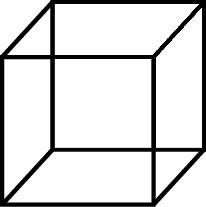 .
.
Some of this may seem unrelatable, like I’m describing an experience that I’ve had, and you have not, and I’m trying to convince you that it’s worth having.
But is this different from other works of philosophy? You may retort that philosophy makes reasonable cases for accepting something as true. I agree. We’ve only just emerged from the aphoristic layer and my case will now be more overt. But the question is also the role of argumentation, for arguments and reasons are ways to lead you to see what the philosopher has seen. “I have myself always thought of a mathematician [or a philosopher] as in the first instance an observer, a man [sic] who gazes at a distant range of mountains and notes down his observations […]. [W]hen he sees a peak he believes that it is there simply because he sees it. If he wishes someone else to see it, he points to it, either directly or through the chain of summits which led him to recognize it himself.”[2]
For any philosophy worth its salt, this seeing entails a corresponding transformation in the seer. “Metaphysics is a questioning in which we inquire into beings as a whole, and inquire in such a way that in so doing we ourselves, the questioners, are thereby also included in the question, placed into question.
“Accordingly, fundamental concepts are […] concepts of a properly peculiar kind. In each case they comprehend the whole within themselves, they are comprehensive concepts [Inbegriffe].[3]Yet they are also comprehensive in a second sense which is equally essential and which ties in with the first: they also in each case always comprehend within themselves the comprehending human being and his or her [sic] Dasein [i.e., there-being][…]. Metaphysical thinking is comprehensive thinking in this double sense. It deals with the whole and it grips existence through and through.”[4]
Am I implying a distinction between (at least) two kinds of philosophy (e.g., transformative and more ‘mundane’ philosophy)? — Perhaps there’s philosophy that renovates the house, adds an extension on, and then there’s that which tidies it up.
[1] For “internal relations,” see Wittgenstein, Tractatus, excerpts from §4.122 and §4.123, cited in Zwicky, W&M, RH98; see also LH98.
[2] G.H. Hardy, “Mathematical Proof,” Mind 38 (1929): p. 18, quoted in Zwicky, W&M, RH64.
[3] German included in original text.
[4] Martin Heidegger, The Fundamental Concepts of Metaphysics: World, Finitude, Solitude, trans. William McNeill and Nicholas Walker (Indianapolis: Indiana University Press, 1995), p. 9.