3.34
The prismatic gods don’t just mend a world in three-dimensional space: instead, a world always extends in numerous overlapping dimensionalities, for it incorporates and is an incorporation of divergent spatial and temporal (including historical) dimensions. Things fit together irreconcilably, which causes perturbations in each world.
Worlds aren’t separate planets drifting either together or apart in space. Instead, to catch a wisp of world, to encounter another world, is for our supposed globeto morph, almost as though to the shape of an infinity sign, with the intersection in the middle of the sign representing a hole in the world (∞). However, one’s own globe appears larger, so the sign would have to be redone in a lopsided way, one side bigger than the other.
But to catch a wisp of world is for our globe to protrude in one place, without the symmetry delineated by the ∞ sign — like a bubble linked to another:. Or like a protrusion inwards
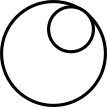
where one can sense that if the hole were to grow to full proportions
— if one were to fully ‘see things like this’ (an impossibility) — the inward protrusion would reach the ‘walls’ of one’s own globe and fully replace it. As mentioned, getting too close to the holes, plunging into the other’s world, risks losing one’s own (§3.14).
But, more accurately, holes are already occurring on multiple fronts, at multiple points —

— where each protrusion itself reiterates, uniquely, this interplay from different perspectives each time (i.e., irreconcilably, not in 3D space).
—— Yes, the globe is just an image, and probably a bad one at that. Being isn’t round, as per Parmenides.[1] Let’s dispense with this image, for a world is not a globe, not a sphere (§1.54).
[1] Parmenides, fr. 8, in A Presocratics Reader, p. 48.